What Is HIFU Face Lifting? A Complete Guide to Ultraformer MPT
How focused ultrasound lifts from deep within the skin — who it suits, what to expect, and what makes MPT different.
Quick answer
Ultraformer MPT HIFU: what to know first
Ultraformer MPT delivers focused ultrasound at selected tissue depths and may suit mild-to-moderate facial or jawline laxity. The treatment depth, energy and number of shots should follow an individual anatomy assessment rather than a fixed package.
- Suitable for
- Mild-to-moderate facial or jawline laxity after a tissue-depth assessment
- Discuss first
- Discuss pregnancy, active infection, implanted devices, metal and previous procedures with the doctor
- Discomfort
- Brief deep warmth, tingling or tenderness; intensity varies by area and settings
- Downtime
- Redness, swelling or tenderness can occur; recovery varies
- When change may be noticed
- Change is usually gradual and is better judged at follow-up than immediately
- Alternatives
- Monopolar RF, another tightening plan or surgical assessment may better match a different degree of laxity
HIFU — high-intensity focused ultrasound — has become the most requested non-surgical lifting treatment in Bangkok, and for good reason. It lifts and tightens from deep within the skin with no incisions and almost no downtime. But not all HIFU is the same. This guide explains how it works, what makes Ultraformer MPT different, who it suits, and the results you can realistically expect.
What is HIFU, and how does it lift?
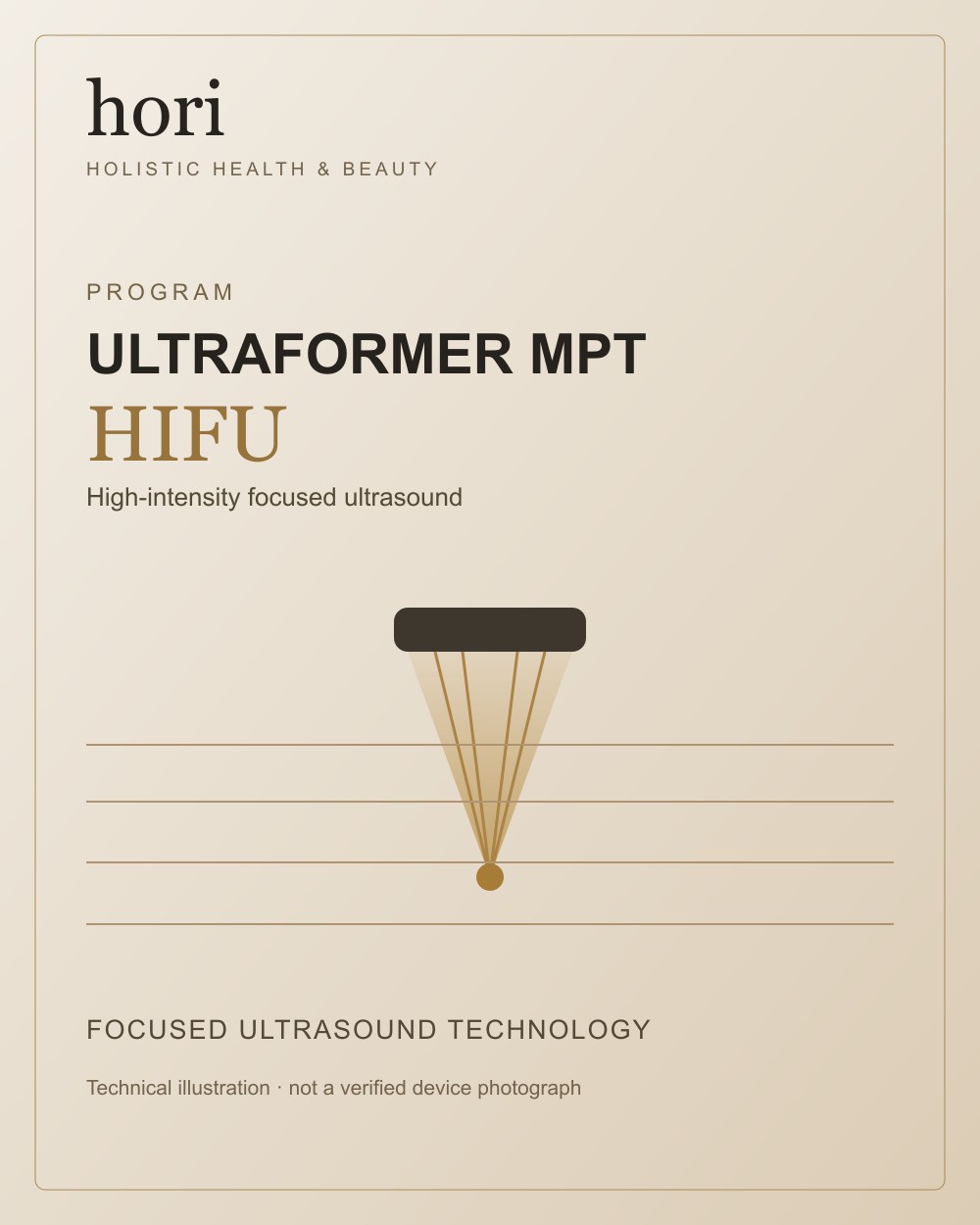
HIFU delivers focused ultrasound energy to precise depths beneath the skin, creating tiny points of controlled thermal coagulation. Crucially, it can reach the SMAS layer — the same deep support layer a surgeon tightens during a facelift — without touching the surface of the skin. The micro-injuries trigger neocollagenesis: your body's natural process of building new collagen and elastin over the following weeks.
Energy is typically delivered at three depths — roughly 4.5 mm (SMAS), 3.0 mm (deep dermis) and 1.5 mm (superficial dermis) — so a single session can lift deep structure and refine surface texture at the same time.
Why Ultraformer MPT is different
"MPT" stands for Micro Pulsed Technology. Where older HIFU fires single, widely-spaced shots that can feel sharp, MPT delivers energy in a faster, more continuous micro-pulsed motion. In practice that means three meaningful advantages:
- More comfort. Energy is spread more evenly, so most people tolerate it with little to no numbing.
- Faster sessions. The continuous motion covers an area more quickly than dot-by-dot shots.
- Even coverage. Smoother energy distribution helps avoid hot-spots and supports a natural, uniform lift.
The machine matters — but the hand guiding it matters more. The depth, lines and energy are chosen by a doctor for your anatomy, not a fixed template.
Who is HIFU lifting for?
Ultraformer MPT suits people who notice early to moderate laxity and want a firmer contour without surgery. It is a strong choice if you want to:
- Lift a softening jawline or early jowls
- Reduce a double chin and define the chin–neck angle
- Firm sagging cheeks and lift the brow subtly
- Improve overall skin tightness with no downtime
It is less suitable if you have very advanced sagging with significant excess skin (where surgery may be more appropriate), are pregnant, or have active infection or implants in the treatment area. A consultation is the only way to know for certain — which is exactly why every plan at Hori begins with one.
What a session feels like — and downtime
After cleansing and mapping the treatment lines, your doctor glides the handpiece across the face. You will feel warmth and occasional tingling as energy reaches the deeper layers — a sign it is working. A full face and neck usually takes about 30–50 minutes.
Because nothing is cut, downtime is minimal. Mild redness or slight tenderness can occur and typically settles within hours to a couple of days. Most people return to normal activities and makeup the same day.
When will I see results?
There are two phases. An immediate tightening is often visible from the heat-driven collagen contraction. The more meaningful change is gradual: as new collagen forms, lift and firmness build over 8–12 weeks and continue to improve for up to three months. Results commonly last around 12–18 months, after which a maintenance session helps preserve the effect. Outcomes vary with age, skin condition and lifestyle.
The short version
- HIFU lifts the deep SMAS layer without surgery or real downtime.
- Ultraformer MPT adds comfort, speed and even coverage via micro-pulsed energy.
- Best results build over 8–12 weeks and last roughly 12–18 months.
Frequently asked questions
Is HIFU painful?+
Most people describe brief warmth and tingling rather than pain, especially with MPT's even energy delivery. Comfort can be adjusted, and numbing cream is available if you prefer.
How many sessions do I need?+
Many people see a clear result from a single session, with maintenance every 12–18 months. Your doctor will advise based on your skin and goals at the consultation.
HIFU or RF (Oligio) — which should I choose?+
They work at different depths and are often complementary — HIFU targets the deep SMAS for lift, while RF tightens the dermis for skin quality. Many plans combine both. See our comparison article below.
Is there any downtime?+
Very little. Mild redness or tenderness may appear briefly and usually settles within hours to a couple of days. Most people resume normal life and makeup the same day.
At what age should I start?+
There is no fixed age. Many begin in their early 30s as the first signs of laxity appear, using HIFU preventively; others start later to address established sagging. A consultation determines the right timing for you.