Sculptra vs Radiesse vs Juvelook: Which Biostimulator Fits You?
Three ways to make your skin rebuild its own collagen — compared by mechanism, area and timeline.
Quick answer
How do Sculptra, Radiesse and Juvelook differ?
Sculptra, Radiesse and Juvelook are injectable products with different materials, handling and intended roles; they are not interchangeable “collagen shots.” A physician may consider broad gradual support, structural support or selected skin-quality concerns according to the product and anatomy. Choice depends on the treatment area, tissue, goal, medical history and risk—not on a single ranking of which product is best.
- Suitable for
- People whose area, tissue and goal match a specific product after examination.
- What to expect
- Change is generally gradual and varies by product, placement, response and follow-up.
- Risks
- Swelling, bruising, infection, lumps or other injection complications can occur and require appropriate technique.
- Downtime
- Temporary swelling, tenderness or bruising may affect social plans; recovery varies.
- When to see a doctor
- Before choosing a product, and urgently for severe pain, blanching, visual symptoms, worsening swelling or infection signs.
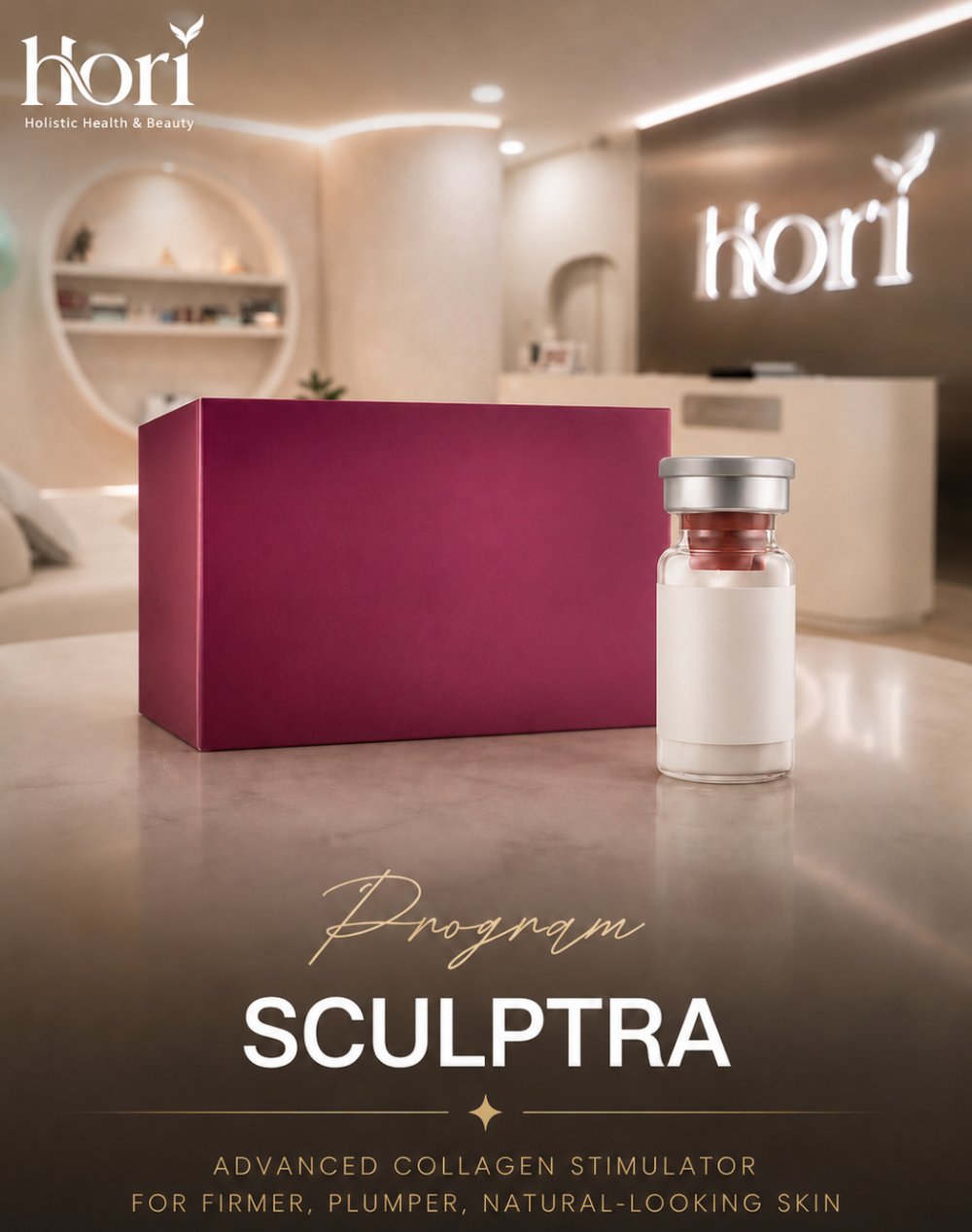
Filler adds volume instantly. Biostimulators play a longer game: they seed the skin with micro-particles that train your fibroblasts to rebuild collagen — so the volume and firmness you gain is your own tissue. Three products lead this category at Hori, and they are not interchangeable.
How biostimulators work
Each product carries biodegradable particles — poly-L-lactic acid (PLLA), calcium hydroxylapatite (CaHA) or poly-D,L-lactic acid (PDLLA) — that trigger a controlled regenerative response. Over weeks, fibroblasts lay down fresh collagen around them. The particles safely dissolve; the collagen stays.
Sculptra — the gradual full-face rebuilder
Sculptra (PLLA) is the choice for overall volume loss — gaunt cheeks, sunken temples, the "deflated" look after weight loss. Results build over 2–3 sessions and mature at 3 months, lasting up to ~2 years. It rewards patience with the most natural full-face restoration.
Radiesse — instant lift plus collagen
Radiesse (CaHA) gives partial immediate lift from its gel carrier, then keeps building collagen for months. Diluted, it becomes a skin-tightening "hyperdilute" treatment for jawline, neck and hands. Best for defined structure and laxity rather than soft diffuse volume.
Juvelook — the skin-quality specialist
Juvelook (PDLLA + HA) uses finer particles designed for delicate work: shallow acne scars, enlarged pores, crepey under-eye skin and overall skin quality. Think of it as a collagen skin-booster rather than a volumizer — often paired with RedTouch Pro in scar plans.
Side-by-side
- Volume loss, full face → Sculptra: gradual, natural, ~2 years
- Jawline, laxity, hands → Radiesse: partial instant lift + collagen
- Skin quality, scars, under-eye → Juvelook: fine-particle rebuilding
- Timeline (all) → first change ~4–6 weeks, full result 2–3 months after the course
Fillers borrow volume; biostimulators earn it back.
The short version
- All three make your body rebuild its own collagen — results are gradual but long-lived.
- Sculptra = full-face volume, Radiesse = structure & laxity, Juvelook = skin quality & scars.
- Expect the real result at 2–3 months — patience is part of the protocol.
Frequently asked questions
How is a biostimulator different from filler?+
Filler adds instant HA gel volume; biostimulators trigger your own collagen, so results appear over 2–3 months but last longer and feel like your own tissue.
Sculptra or Radiesse — which one?+
Sculptra for diffuse full-face volume loss; Radiesse for jawline definition, laxity and hands where some instant lift helps. Your doctor may combine them across areas.
Who is Juvelook for?+
Anyone prioritising skin quality: shallow acne scars, pores, thin under-eye skin. It is the fine-detail member of the family.
When will I see results, and how long do they last?+
First changes around 4–6 weeks, full results 2–3 months after completing the course, lasting roughly 18–25 months depending on the product.